5 min read
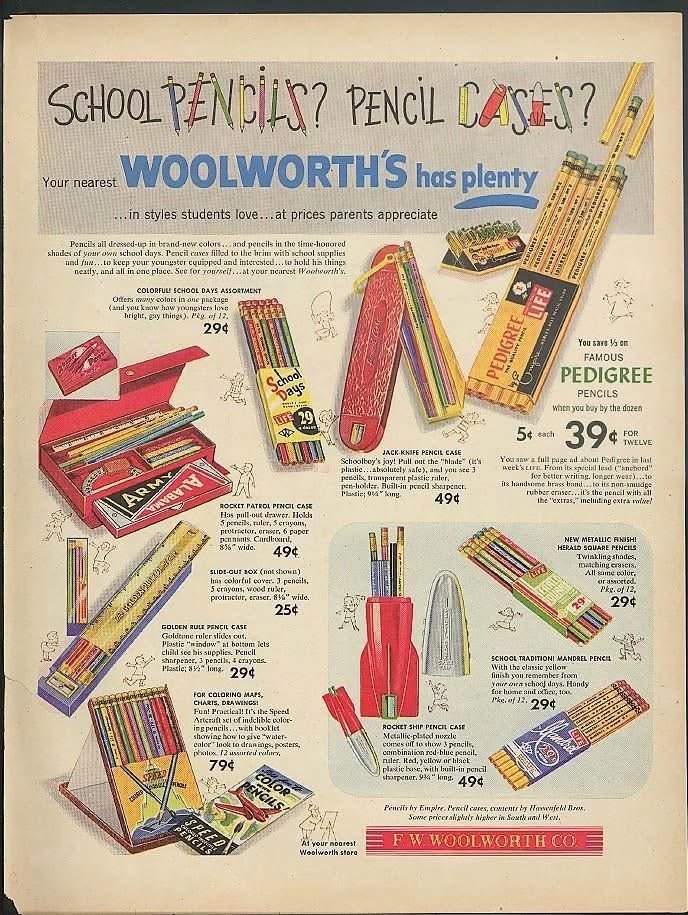
A vintage Woolworth’s advertisement published in LIFE magazine in 1953 takes us back more than seventy years to the back-to-school season. From wooden pencils and pencil cases to colored pencils and prices that look striking today, one advertisement gives us a small glimpse into school life and back-to-school shopping in another era.
Article Content
Back to School in 1953… What Was in a Student’s Pencil Case?
Some things change in appearance over time while remaining a familiar part of school memories.
A new pencil, a box of colored pencils, a carefully chosen pencil case, and the supplies prepared before the beginning of a new school year.
These details may seem completely familiar today, but a vintage advertisement from 1953 shows us what they looked like more than seventy years ago.
The image is a Woolworth’s advertisement published in the August 31, 1953 issue of LIFE magazine.
At first glance, it takes us straight into the back-to-school season.
“School Pencils? Pencil Cases?”
The advertisement begins with two large questions:
“School Pencils? Pencil Cases?”
The answer follows immediately:
“Woolworth’s has plenty.”
The message was simple: students could find many of the supplies they needed for school at Woolworth’s.
More than seventy years later, however, the advertisement itself has become just as interesting as the products it was created to sell.
It is a small snapshot of back-to-school shopping in 1953.
Look at the Pencil Cases
The pencil cases are among the most striking details.
There was no single standard design.
We can see a rocket-shaped case, a long slide-out design, a large red case, and several others featuring different shapes and colors.
Some were designed not simply to hold pencils but to organize several school essentials together.
And here we discover something surprisingly familiar:
Even in the 1950s, school supplies were not purely practical. Their appearance and design were part of their appeal to students.
The advertisement itself emphasizes styles students would enjoy alongside prices their parents could appreciate.
What Can We See in the Advertisement?
There are wooden pencils, colored pencils, pencil cases in different designs, rulers, a pencil sharpener, an eraser, and other small school essentials.
There are, of course, no screens, electronic devices, or digital tools.
Compared with a student’s world today, these supplies may appear very simple, yet they formed a familiar part of preparing for school.
Interestingly, some things have changed very little.
More than seventy years later, pencils, erasers, sharpeners, colored pencils, and pencil cases still appear on back-to-school shopping lists, even though laptops, tablets, calculators, and other modern tools may now sit beside them.
The Prices Tell a Story Too
Some of the most eye-catching details are the prices printed beside the products.
The advertisement includes prices such as 25¢, 29¢, 49¢, and 79¢ for various items and sets.
These figures, however, should not be compared directly with prices today.
The purchasing power of a dollar in 1953 was very different from its purchasing power now, so a small number on an old advertisement does not necessarily mean that an item was inexpensive by the standards of its time.
Still, seeing original prices is one of the details that makes a vintage advertisement feel more tangible.
It reminds us that we are not simply looking at an old design.
We are looking at products that families actually went into stores and purchased.
An Advertisement for Students—and Their Parents
One charming feature of the advertisement is the way it speaks to two audiences at once.
The colorful products, playful pencil-case designs, and small illustrations scattered across the page are clearly intended to appeal to students.
At the same time, the advertising message emphasizes prices that parents would appreciate.
It is a back-to-school situation that still feels familiar today:
A child may be attracted to the design, while a parent is also thinking about price, quality, and what is actually needed.
The designs have changed, but the experience feels remarkably familiar.
Back to School More Than Seventy Years Ago
The advertisement appeared on August 31, 1953, at the end of summer and during the traditional period of preparing for the new school year.
It is interesting to imagine a family turning the pages of LIFE magazine and stopping at this advertisement.
Perhaps a child chose a favorite pencil case.
Perhaps a parent looked at the prices.
And perhaps a trip to Woolworth’s followed to buy supplies for the coming school year.
To them, none of these objects were “vintage.”
They were brand new.
Look at the Advertisement Itself
Even the design of the page is worth noticing.
There is no large photograph of a student carrying a school bag.
Instead, the products themselves fill most of the page.
Pencils, cases, and colored pencils are arranged around descriptions and prices, with playful little illustrations appearing between them.
The entire advertisement almost resembles a colorful school page filled with drawing and movement.
That is part of the pleasure of looking at vintage advertising.
We do not simply discover old products. We also see how designers tried to capture people’s attention decades before digital advertising and social media.
The Tools Changed… The Feeling Remained
Today, a back-to-school list may include a tablet, laptop, headphones, and chargers alongside notebooks and pencils.
Bags and pencil cases have changed, and countless new designs and brands have appeared.
Yet something about this advertisement still feels very familiar.
The excitement of new supplies.
Choosing a pencil case.
Opening a new box of colored pencils.
And knowing that a new school year is about to begin.
What students carry to school may have changed…
But perhaps the excitement of preparing for the first day of school never really gets old. 🤍
Memories of Days Gone By ᥫ᭡
Rana Elgogary
Expert Tip
«Look closely at the simple things in old photographs… A pencil or a pencil case may seem ordinary, yet sometimes it carries the memories of an entire generation and the way they prepared for everyday life. Memories of Days Gone By ᥫ᭡ Rana Elgogary»
Conclusion
A 1953 Woolworth’s advertisement published in LIFE magazine takes us back more than seventy years to the back-to-school season. Through its pencils, pencil cases, colored pencils, prices, and page design, we discover not only what school supplies looked like, but also how retailers appealed to students and parents. School tools have changed considerably, yet the excitement of choosing new supplies for a new school year still feels familiar today.