5 min read
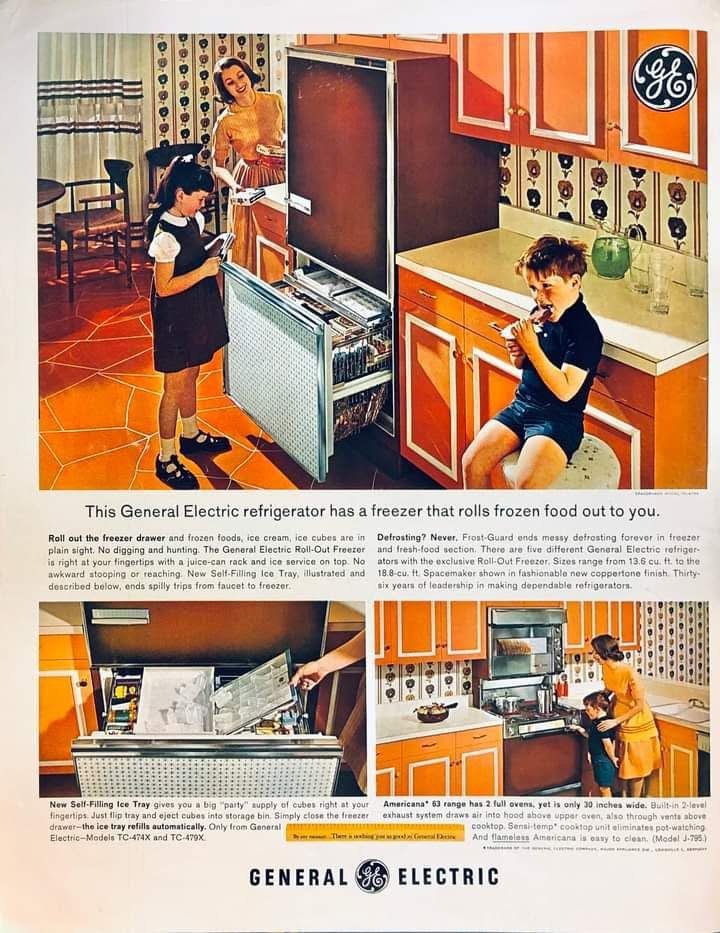
A vintage General Electric advertisement takes us inside an American kitchen of the early 1960s, when the modern refrigerator represented far more than food storage. A roll-out freezer, a self-filling ice tray, and features designed to simplify everyday tasks reflected a new vision of comfort and modern living.
Article Content
The Kitchen of the Future in the Early 1960s… When the Freezer Rolled Out to You
Some vintage images preserve more than the appearance of old objects. They also preserve the way life once unfolded around them.
A single refrigerator advertisement can draw our attention to the kitchen design, cabinet colors, family clothing, surrounding appliances, and even the small conveniences that were once presented as the latest developments in modern living.
That is exactly what makes this vintage General Electric advertisement so fascinating.
At the center of the colorful kitchen stands a large refrigerator with a striking feature: instead of a conventional freezer door, the lower section contains an entire freezer that pulls outward.
The idea emphasized in the advertisement was simple: rather than searching inside the freezer, the freezer could be rolled outward, bringing frozen food within easier reach.
When the Freezer Became a Large Drawer
General Electric called the feature the Roll-Out Freezer.
Instead of bending and searching for something hidden at the back, the user could pull the freezer outward and see its contents more clearly, while sliding baskets helped organize frozen foods and make them easier to reach.
The idea may seem familiar today, as drawer-style freezers are common in many modern refrigerator designs. At the time, however, features like this reflected an important shift in household appliance design.
The question was no longer simply:
Does the appliance perform its function?
Another question was becoming equally important:
Can it make everyday use easier and more convenient?
Even the Ice Tray Became Smarter
Another interesting feature highlighted in the advertisement was the Self-Filling Ice Tray.
The idea addressed a small but repetitive household task: carrying an ice tray to the sink, filling it with water, and returning it to the freezer while trying not to spill it.
The system was designed to help refill the tray when the freezer was returned and closed.
By today’s standards, this may sound like a modest convenience, but it reveals something important about the history of design:
Not every innovation begins with a revolutionary invention. Sometimes it begins by noticing a small everyday inconvenience and finding a better way to handle it.
And What About Defrosting?
Frost accumulation was a familiar issue in many older freezers, making manual defrosting and cleaning another household chore.
The advertisement therefore also highlights Frost-Guard, a General Electric system promoted as reducing the need for traditional manual defrosting.
This reflects an important change in how household appliances were being presented.
The company was not simply selling an appliance that kept food cold. It was also selling convenience and reduced time and effort.
The Kitchen Itself Is Part of the Story
But the beauty of this advertisement extends far beyond the refrigerator.
Look at the entire scene.
The orange cabinetry, brown tones, pale countertops, patterned wallpaper, flooring, dining area in the background, and the clothing and hairstyles of the mother and children.
Together, these details transform the page into a small window onto another era.
Household advertisements did not simply display appliances. They often created a complete picture of the life consumers might imagine living around them.
The message was not only:
Here is a new refrigerator.
It was also:
This is what your modern home could look like.
Colors That Once Represented Modernity
Orange, brown, and bold patterns may immediately evoke the past for us today, but this is one of the most fascinating aspects of design history.
What looks vintage to us now was once new and contemporary.
Memories of Days Gone By ᥫ᭡
Rana Elgogary
Expert Tip
«When looking at a vintage photograph or advertisement, do not focus only on the product. Notice the clothing, colors, furniture, appliances, and the way people use the space. Details that once seemed ordinary may now tell us more about how an entire generation lived. Memories of Days Gone By ᥫ᭡ Rana Elgogary»
Conclusion
This vintage General Electric advertisement reveals how household appliances in the early 1960s were increasingly presented around the ideas of convenience and ease of use, from the Roll-Out Freezer and Self-Filling Ice Tray to the Frost-Guard system. Today, however, the advertisement offers much more than refrigerator history. Its kitchen colors, cabinetry, clothing, appliances, and carefully staged family scene preserve a vivid picture of what was once presented as modern, comfortable home life. What once represented the kitchen of the future has now become a fascinating window into the past.