5 min read
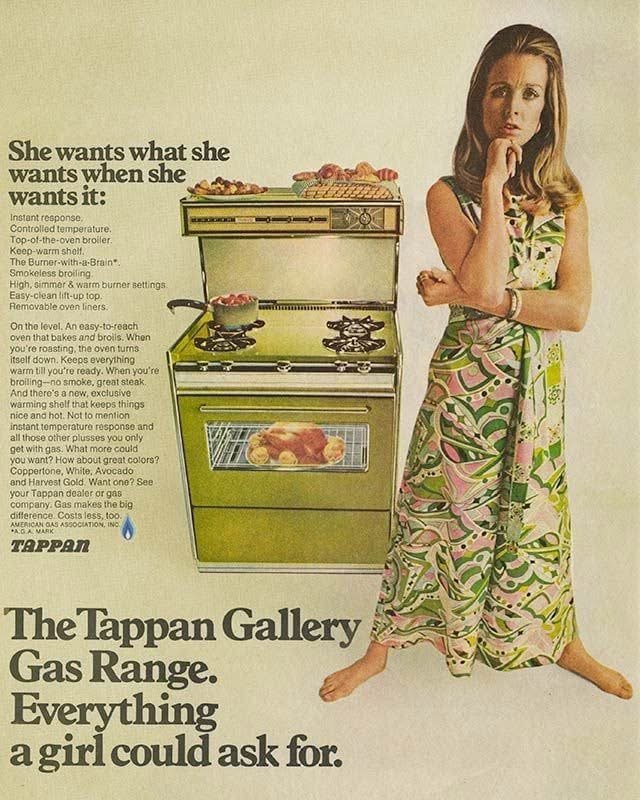
The Kitchen of 1969… When Home Technology Was Sold as “Everything a Girl Could Ask For” Short Description In a 1969 advertisement, a young woman stands beside the Tappan Gallery Gas Range, while the copy promises easier cooking, temperature control, convenient cleaning, and greater comfort in the kitchen. Yet what stands out most today is not simply the appliance but the line chosen to sell it: “Everything a girl could ask for.” This article takes us back to the kitchen of the late 1960s to explore what counted as advanced household technology and what the advertisement’s colors, design, fashion, and language reveal about ideas of women, home, and modern life at the time.
Article Content
The Kitchen of 1969
Some vintage advertisements capture our attention because of the product.
Others make us stop and look at an entire era.
A young woman stands barefoot in a long patterned dress beside a green gas range whose design now immediately evokes the late 1960s.
Across the bottom of the page:
“The Tappan Gallery Gas Range. Everything a girl could ask for.”
More than half a century later, the wording is striking.
Was a gas range really “everything a girl could ask for”?
Of course, we are looking at advertising language, not a factual description of women’s aspirations.
But that is precisely what makes the page interesting.
Vintage advertisements do not simply tell us what companies sold.
They can also reveal who advertisers imagined their customer to be and what they believed would appeal to that customer.
1. The Year Is 1969
This advertisement appears in the May 1969 issue of American Home, allowing us to place it firmly within its historical moment.
Fashion, household design, color, typography, and appliance technology were all changing.
Much of that visual culture is captured on this single page.
It is more than an appliance advertisement.
It is a small visual document of its era.
2. The Green Was Not Accidental
The advertisement offered colors including Avocado, Harvest Gold, Coppertone, and white—tones strongly associated with American kitchens of the period.
Appliances did not necessarily disappear into neutral interiors.
A range or refrigerator could become a major color element in the room.
Today, those shades can almost function as timestamps.
3. What Did the Range Actually Offer?
The advertisement highlights features including temperature control, an upper broiler, a warming shelf, low-smoke broiling, multiple burner settings, an easy-clean lift-up top, and removable oven liners.
Some may sound ordinary now.
But that is exactly why they are historically interesting.
They show us which everyday problems appliance designers and advertisers were trying to solve:
better control,
easier access,
simpler cleaning,
keeping food warm,
and reducing effort during meal preparation.
4. Making the Oven Easier to Reach
The advertisement describes an upper oven as easy to reach.
That reminds us that innovation does not always require inventing an entirely new function.
Sometimes it means reconsidering the relationship between the human body and an everyday object.
Where should the oven be positioned?
How much bending is required?
Can food be checked more easily?
Comfort can begin with something as simple as placement.
5. A Shelf That Kept Dinner Warm
The range also included a warming shelf, allowing food to remain warm while other parts of the meal were still being prepared.
This solved a very ordinary problem.
Different foods do not always finish cooking at exactly the same moment.
A small design feature could therefore make coordinating a meal easier.
Many household innovations begin this way—not with spectacular inventions, but with small frustrations repeated every day.
6. Cleaning Became Part of the Technology
The advertisement promotes a lift-up top and removable oven liners designed to make cleaning easier.
An appliance does not create only its primary task.
Cooking also creates cleaning.
Once designers begin considering what happens after use, they are designing the entire experience rather than simply the cooking function.
The same principle remains important in appliances today.
7. Control Was Part of the Promise
The advertisement also emphasizes the responsiveness of gas heat.
The message is not merely about producing heat.
It is about controlling it.
Choose a setting.
Receive a response.
Manage the cooking process with greater precision.
Technology has changed dramatically, but control remains one of the major promises used to sell cooking appliances today.
8. Why “Everything a Girl Could Ask For”?
This is perhaps the most revealing part of the page.
The copy does not say:
“Everything a family could ask for.”
Nor:
“Everything a modern kitchen needs.”
It says:
“Everything a girl could ask for.”
The choice directly links household technology with women.
Yet we should be careful not to interpret the advertisement as proof that all women in 1969 thought this way.
It demonstrates something different:
advertisers chose to speak to women this way.
That distinction matters.
Advertising can be an excellent cultural source, but it often documents the image marketers wanted to create—not the complete reality of society.
9. She Is Not Cooking
Visually, another detail is fascinating.
The woman is not shown preparing food.
She is not holding a pan or cleaning the oven.
She stands beside the range almost like a fashion model.
The appliance therefore becomes part of a lifestyle image.
The message is not simply:
This range performs useful functions.
It also suggests:
This is an appliance for the modern woman.
Products are often sold not only through what they do, but through the identity and lifestyle consumers are invited to associate with them.
10. The Dress Is Historical Evidence Too
Remove the appliance and advertising copy, and the photograph would still look unmistakably vintage.
The long dress.
The swirling pattern.
The greens and pinks.
The hairstyle.
The jewelry.
All of them help turn the advertisement into a visual time capsule.
When looking at vintage advertising, do not focus only on the product.
Look at the clothing.
Colors.
Furniture.
Hair.
Typography.
Body language.
Sometimes the most revealing historical information exists outside the product being sold.
11. What Does a “Modern Kitchen” Mean?
In 1969, accessible ovens, warming shelves, easier cleaning, and improved heat control could contribute to an image of an advanced kitchen.
Today, the list may include induction cooking, electronic controls, automated programs, sensors, connected ovens, and increasingly sophisticated cleaning systems.
The technologies change.
The fundamental promise remains familiar:
household technology should save us something.
Time.
Effort.
Steps.
Or constant attention.
Every generation has its version of the “kitchen of the future.”
Then the future arrives, and yesterday’s innovation becomes ordinary.
12. Advertising Changed Too
A contemporary range may be marketed through performance, energy use, design, technology, capacity, convenience, or lifestyle.
A phrase such as “Everything a girl could ask for” would be read very differently today.
It immediately raises another question:
Why should an appliance be assumed to belong to one gender at all?
This is one of the reasons vintage advertising is valuable.
We do not need to return to it simply to mock the past or judge it exclusively through present-day standards.
We can use it to understand what changed—in technology, language, design, and social expectations.
13. An Advertisement Preserves More Than a Product
If only the physical range survived, we could study its engineering and design.
The advertisement gives us something more.
It preserves the story marketers built around the object.
Who was supposed to use it?
What did that person supposedly want?
Which problems did the appliance promise to solve?
What identity did the brand connect to the product?
That makes vintage advertising a small historical document.
Not because it tells us the whole truth about an era.
But because it shows us how an era chose to present certain ideas.
14. More Than Half a Century Between Two Kitchens
Today, the green Tappan range looks unmistakably old.
In 1969, however, the advertisement presented it through convenience, choice, and modern features.
That is one of the beautiful paradoxes of design history:
Everything that looks old today was once new.
And everything we consider advanced today will eventually become someone’s vintage photograph.
Perhaps decades from now, someone will examine an advertisement for a smart kitchen from 2026 and smile at the technologies we considered futuristic.
Just as we now look at the Tappan Gallery.
What Does This Page Really Tell Us?
It tells us about a gas range.
But also about the colors of 1969 kitchens.
Ideas of domestic convenience.
Appliance design.
Women in advertising.
The language used to sell household technology.
And the remarkable ability of an everyday product to preserve details of an entire era.
Perhaps the most important line to remember is not the advertisement’s:
“Everything a girl could ask for.”
Instead, it may be the question we can ask today:
Who decided what a woman was supposed to ask for in the first place?
Vintage advertisements do not simply tell us what people were buying.
Sometimes they reveal what society imagined people should want.
And that is when an old advertising page becomes something more than a product image.
It becomes a piece of memory from days gone by. ᥫ᭡
Memories of Days Gone By ᥫ᭡
Rana Elgogary
Expert Tip
«When looking at a vintage advertisement, do not focus only on the product being sold. Look at who is being addressed, the language being used, the clothing and colors, the setting, and the problem the product promises to solve. The story of an era may be hiding in the details surrounding the product rather than in the product itself. Memories of Days Gone By ᥫ᭡ Rana Elgogary»
Conclusion
The 1969 Tappan Gallery Gas Range advertisement takes us back to a time when features such as an easier-to-reach oven, a warming shelf, temperature control, and easier cleaning were presented as elements of a modern kitchen. Yet the advertisement reveals far more than the history of an appliance. Its colors, fashion, and especially the phrase “Everything a girl could ask for” show how household technology was marketed directly to women at the time. Reading these details allows us to see not only how kitchens and appliances changed, but also how the language surrounding women, home, and technology evolved.