5 min read
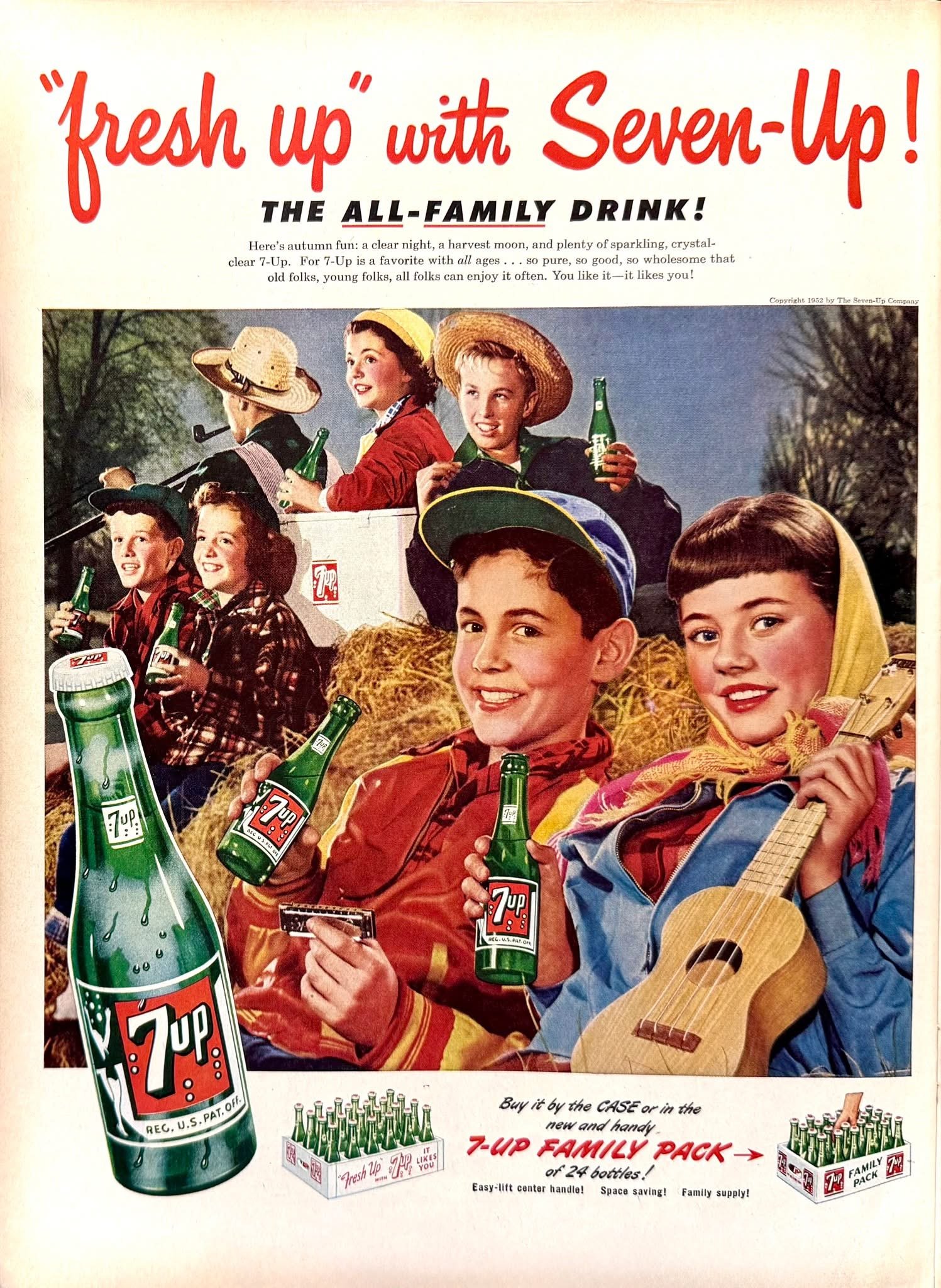
This colorful 1952 7UP advertisement takes us back to an era when advertising did more than simply display a product—it created an entire scene around it. Children and young people, an autumn setting, music, outdoor fun, and bottles of 7UP come together under the message “The All-Family Drink.” The advertisement offers a fascinating glimpse into how brands connected products with family life, leisure, and shared moments.
Article Content
7UP in 1952… When Advertising Sold a Family Moment
More than seventy years ago, there were no social-media feeds, short-form videos, or advertisements appearing on a phone screen every few minutes.
Magazine pages were an important space where brands competed for attention.
Simply displaying a bottle and a brand name was not always enough.
Advertising needed a story.
This vintage 7UP advertisement, carrying a 1952 copyright notice, is a wonderful example.
We do not simply see a soft drink.
We see an entire scene built around fun, activity, and togetherness.
“Fresh up with Seven-Up!”
Across the top of the page appears the large slogan:
“Fresh up with Seven-Up!”
Immediately underneath is another important message:
“The All-Family Drink!”
This was not simply a phrase used in one advertisement. U.S. copyright records from the early 1950s document numerous Seven-Up advertisements built around the idea of the “all-family drink,” often connecting the beverage with family fun and shared occasions.
This changes the way we read the image.
The advertisement is not only selling a drink.
It is selling the moment in which the drink appears.
Look at the Scene
A group of young people are outdoors.
There are colorful clothes and hats, an autumn atmosphere, music, movement, and cheerful expressions.
And almost everywhere we look, someone is holding a bottle of 7UP.
The visual message is simple:
This drink belongs in moments like these.
Outings.
Gatherings.
Music.
Fun.
Time spent together.
It is a classic advertising idea that remains familiar today: rather than selling only the physical product, connect it to a feeling or experience that people would like to share.
Why “The All-Family Drink”?
During this period, Seven-Up advertising repeatedly positioned the beverage as something for the whole family.
Historical copyright records preserve campaigns describing it as an all-family drink and associating it with family occasions and fun.
The advertisement in front of us follows the same strategy.
Its smaller copy describes the drink as a favorite across different ages.
Some of the health-oriented advertising language common in the mid-20th century would be approached more cautiously by modern standards. Historically, however, such wording tells us a great deal about how brands wanted consumers to perceive their products at the time.
Family Fun Beyond the Dinner Table
Interestingly, the advertisement does not show a conventional family seated around a dining table.
Instead, the setting is outdoors.
There is music, activity, casual clothing, and a sense of leisure.
“Family” is therefore communicated not only through the home, but through shared enjoyment.
The page almost feels like a snapshot from an enjoyable day rather than a straightforward commercial.
Clothing Becomes Part of the History
Vintage advertisements are fascinating because they allow us to notice details that were never intended to be the main subject.
Look at the clothes.
The hats.
The scarves.
The hairstyles.
The colors.
Even the way the bottles are held.
To a reader in 1952, these details would have appeared contemporary and ordinary.
To us, they have become part of the visual history of the era.
Something once completely ordinary can become, decades later, a small document of everyday life.
The Green Bottle Takes Center Stage
Despite the many people and details, the green 7UP bottles remain impossible to miss.
A dramatically enlarged bottle dominates the lower portion of the advertisement, ensuring that the product remains instantly recognizable.
The people create the story.
The bottle remains the star.
And Then Comes the Family Pack
At the bottom of the page, the advertisement shifts from atmosphere to purchase.
It promotes the:
7-UP FAMILY PACK
containing 24 bottles.
The advertisement encourages customers to buy 7UP by the case or in this convenient family pack.
This is an important detail.
After visually connecting the drink with family and shared fun, the advertisement offers a package designed to keep a larger supply at home.
The word “family” therefore extends beyond the slogan into the way the product itself was marketed and sold. U.S. copyright records from the period also document Seven-Up advertising for a 24-bottle family supply.
From a Bottle to a Lifestyle
Today we often use the term lifestyle advertising for campaigns that place products within an attractive experience or way of life.
This advertisement offers a wonderfully clear early example of the principle.
Instead of simply saying:
“Buy 7UP,”
it creates a world around the product.
Beautiful weather.
Companionship.
Fun.
Music.
Outdoor activity.
And then it places the bottle at the center of it all.
The implied message becomes:
7UP belongs to the good times we share.
What the Advertisement Tells Us About the 1950s
Vintage advertisements should not be treated as literal documentary records of everyday life.
Advertising creates an idealized image designed to make a product desirable.
This page does not tell us that every American family in 1952 lived exactly like this.
What it does reveal is something equally interesting:
This was the kind of image the advertiser wanted consumers to associate with the product.
Family.
Fun.
Vitality.
Abundance.
And a household supply large enough to share.
That is why vintage advertising can help us understand not only what people were buying, but also the lifestyles and aspirations that brands believed would appeal to them.
More Than Seventy Years Later…
A magazine reader in 1952 may simply have noticed the bright colors, smiling faces, and familiar bottles before turning the page.
To that reader, it was a contemporary advertisement for a soft drink.
We see something different today.
We notice the clothes.
The bottle design.
The advertising language.
The presentation of family and youth.
The packaging.
Even the marketing strategy itself.
And that is part of the pleasure of looking at vintage advertising.
A product may survive or change over time…
but the advertisement preserves a small moment from the society in which it was created.
Perhaps that is why this page tells us more than the story of 7UP.
It also shows how a 1952 advertisement transformed a bottle of soda into something larger:
a happy moment shared together. 🤍
Memories of Days Gone By ᥫ᭡
Rana Elgogary
Expert Tip
«Look beyond the product in a vintage advertisement… The clothing, colors, way people gather, and even the words chosen can reveal fascinating details about the society and era in which it was created. Memories of Days Gone By ᥫ᭡ Rana Elgogary»
Conclusion
This 1952 7UP advertisement shows how the brand used the idea of “The All-Family Drink” to associate its product with fun, togetherness, and shared activities. From the clothing and autumn setting to the green bottles and 24-bottle Family Pack, the page preserves details that go far beyond the product itself, offering a glimpse into advertising language, consumer culture, and idealized family imagery of the period.