5 min read
Betsy Wetsy could drink from a bottle and then wet her diaper, and she was sold with clothing, diapers, and miniature baby-care accessories. She became one of the recognizable baby dolls of mid-20th-century America, but the advertisement tells a story larger than the toy itself. Through the phrase “It’s fun to mother Betsy Wetsy,” we can explore how caring for a baby doll became an interactive form of pretend play—and how toy advertising simultaneously reflected contemporary ideas about motherhood, caregiving, and girls’ social roles.
Article Content
Betsy Wetsy… When Caring for a Doll Became Part of Play
Short Description
Betsy Wetsy could drink from a bottle and then wet her diaper, and she was sold with clothing, diapers, and miniature baby-care accessories. She became one of the recognizable baby dolls of mid-20th-century America, but the advertisement tells a story larger than the toy itself. Through the phrase “It’s fun to mother Betsy Wetsy,” we can explore how caring for a baby doll became an interactive form of pretend play—and how toy advertising simultaneously reflected contemporary ideas about motherhood, caregiving, and girls’ social roles.
Betsy Wetsy… When Caring for a Doll Became Part of Play
Some vintage toys are remembered because of how they looked.
Others are worth revisiting because of the idea behind them.
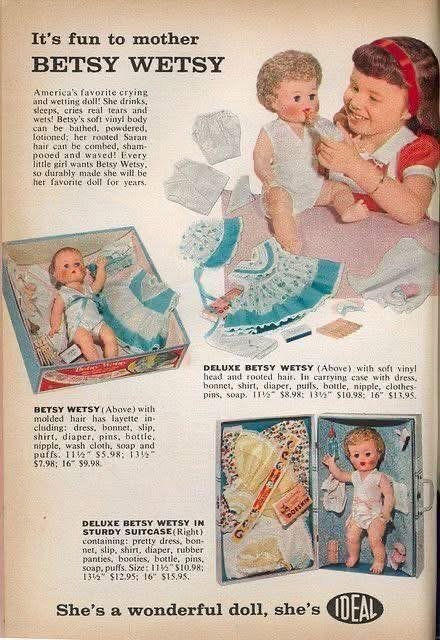
In this advertisement, a young girl holds a baby doll and feeds her from a bottle.
Around them are tiny dresses, diapers, pins, socks, and other accessories that resemble the belongings of a real infant.
At the top is a striking line:
“It’s fun to mother Betsy Wetsy.”
The message was therefore larger than:
Here is a doll to play with.
It suggested:
Here is a little baby you can care for.
And that idea lies at the heart of the story of one of the 20th century’s memorable baby dolls.
A Doll That Responded
Betsy Wetsy became known as a drink-and-wet doll.
A child could give the doll liquid through its bottle, after which the liquid passed through the doll so that its diaper became wet.
Simple by today’s standards, the mechanism gave the toy something important:
cause and effect.
Feed the baby.
Wait.
Change the diaper.
The doll was no longer simply an object to hold. It could participate in a miniature caregiving routine.
The Accessories Were Part of the Story
The advertisement makes another point especially clear: Betsy Wetsy was not being sold in isolation.
There were dresses, shirts, diapers, bottles, nipples, pins, socks, shoes, and other accessories.
Different versions offered different sets of clothing and baby-care items, some presented in carrying cases.
Together they created a miniature world of pretend care.
The child could feed the doll, change her clothes, organize her belongings, change her diaper, put her to sleep, and begin another story.
Why Was This So Appealing?
Children naturally imitate the world around them.
They pretend to cook, talk on telephones, drive cars, go to work, shop, and care for babies.
Betsy Wetsy added an interactive element to this kind of imaginative play.
The doll responded to what the child did.
That made the pretend scenario feel a little more real.
Making Dolls More Like Babies
Throughout the 20th century, doll makers increasingly experimented with ways to make baby dolls resemble and behave more like infants.
The Strong National Museum of Play notes that, particularly with developments in plastics and vinyl during the 1950s, manufacturers created dolls capable of increasingly varied behaviors—from eating and crawling to walking, talking, and responding to children’s voices.
Betsy Wetsy belongs to this broader history of making a toy feel more interactive and lifelike.
But the Advertisement Was Selling More Than Realism
This is where the page becomes especially interesting.
The headline does not simply say:
It’s fun to play with Betsy Wetsy.
It says:
“It’s fun to mother Betsy Wetsy.”
The important word is mother.
The advertisement therefore connected pretend caregiving directly with motherhood.
The Girl in the Advertisement Matters
A young girl is shown caring for her “baby.”
This reflects a broader advertising culture in which many toys marketed to girls were connected to caregiving, domestic life, and motherhood.
That does not mean there is anything unusual about a child enjoying nurturing play.
The more interesting historical question is:
How did advertisers choose to frame that play, and who did they assume should perform it?
That distinction turns the advertisement into a small piece of social history.
Was Betsy Wetsy Teaching Girls to Become Mothers?
It is tempting to make that claim directly, but historical interpretation benefits from more precision.
One advertisement cannot tell us what every girl thought about her doll.
Children may have played with Betsy Wetsy in countless ways that had little to do with the message intended by marketers.
What we can say is that the advertisement itself explicitly framed caring for the doll as practicing a maternal role.
The child’s play and the advertiser’s message are not necessarily the same thing.
A Tiny World Inside a Case
One version shown in the advertisement presents Betsy Wetsy with her belongings inside a carrying case.
The case becomes more than packaging.
Once opened, it contains a miniature life:
the doll,
her clothing,
her diapers,
her bottle,
and her accessories.
This idea remains familiar in modern toys.
Companies often sell not only a character but an entire world around that character.
Materials Changed the Doll, Too
The Strong National Museum of Play preserves a Betsy Wetsy example dated to 1948 made from materials including rubber, plastic, and textile.
The development of new materials mattered enormously to doll design.
More flexible and durable materials allowed manufacturers to create increasingly lifelike bodies and more elaborate functions.
The history of Betsy Wetsy is therefore also a small chapter in the history of materials and mass manufacturing.
More Than a Short-Lived Toy
Betsy Wetsy remained associated with Ideal for decades and became especially recognizable during the postwar baby-boom period.
That longevity matters.
A toy that remains popular for years can become more than a successful product.
It becomes part of a generation’s memory.
An old photograph may bring back a birthday, a holiday gift, a sibling’s toy, or an advertisement once seen in a magazine.
The product becomes personal history.
What Has Changed?
Baby dolls still exist.
Children still enjoy feeding them, dressing them, placing them in strollers, and creating imaginary routines around them.
What has expanded is our understanding of who nurturing play can belong to.
Caregiving is not inherently a girls-only skill.
A baby doll can give any child opportunities for imagination, empathy, care, and simple responsibility through play.
That allows us to separate two things:
the enduring value of nurturing play
from
the historically gendered way such play was often advertised.
A Toy That Imitated Life
Perhaps Betsy Wetsy’s cleverest idea was remarkably simple.
The child did something, and the doll responded.
Give her a bottle.
Then change her diaper.
A miniature sequence became a story.
In today’s world of highly sophisticated electronic toys, that mechanism can seem almost primitive.
But once, it helped make a doll feel remarkably lifelike.
And that reminds us:
What looks like a simple old toy today may once have felt wonderfully innovative.
In the End…
Betsy Wetsy’s story is not only about a doll.
It is about the way toys imitate real life and how children explore the world through imagination.
But it is also a story about advertising.
A short sentence such as:
“It’s fun to mother Betsy Wetsy”
can preserve something of the assumptions and expectations of the period in which it appeared.
Today, we can look at the doll and see imaginative nurturing play.
And we can look at the advertisement and see something else:
a historical image of how motherhood and caregiving were presented to young girls.
The toys adults give children are not always merely objects for passing the time.
Sometimes they are miniature worlds in which children rehearse the life that adults around them have imagined.
And that is when Betsy Wetsy becomes more than a doll.
She becomes a small piece of memory from days gone by. ᥫ᭡
Expert Tip
«When you look at a vintage toy, don’t ask only: What did children play with? Ask another question too: How did adults present that toy to them, and what role or world were children invited to imagine through it? Sometimes the way a toy was advertised reveals as much about its era as the toy itself. Memories of Days Gone By ᥫ᭡ Rana Elgogary»
Conclusion
Betsy Wetsy became a well-known interactive baby doll through her ability to drink liquid from a bottle and then wet her diaper, turning caregiving into part of the play experience. The advertisement, however, reveals another dimension of her history. Its phrase “It’s fun to mother Betsy Wetsy” explicitly framed playing with the doll as an imitation of motherhood. Through the doll, her clothing, diapers, accessories, and the way she was marketed to girls, we can explore the history of toy design and imaginative play alongside changing ideas about caregiving and gender roles.