5 min read
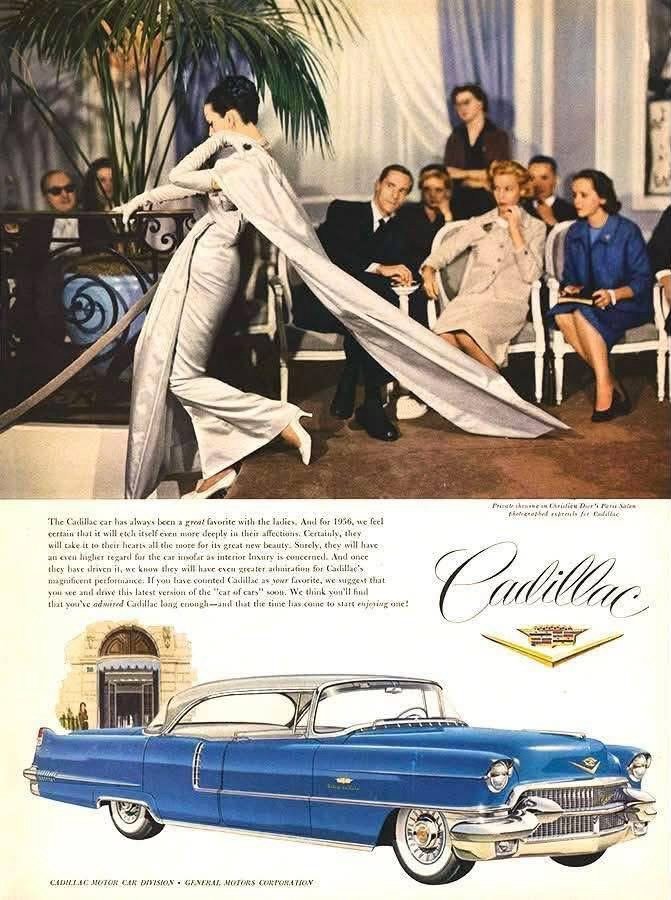
Cadillac 1956… When the Automobile Met the World of Haute Couture Short Description A fashion model walks before an elegantly dressed audience in a dramatic floor-length gown, while a gleaming blue Cadillac occupies the lower half of the advertisement. The combination was no accident. In this 1956 Cadillac advertisement, fashion, beauty, and taste were used to speak directly to women and to present the automobile as something more than transportation. This article looks at the advertisement as a document of its time: what was it saying to women, why did it borrow the language of fashion, and how did the automobile become a symbol of elegance, status, and lifestyle in 1950s advertising?
Article Content
Cadillac 1956… When the Automobile Met the World of Haute Couture
Look at the upper half of the advertisement first.
For a moment, you might not realize that you are looking at an automobile advertisement at all.
A woman walks in an elegant floor-length gown.
A dramatic train follows behind her.
Well-dressed guests watch from their seats.
Palm leaves and draped curtains frame a setting reminiscent of the intimate couture presentations of the mid-twentieth century.
Then your eyes move downward.
A blue Cadillac appears.
And suddenly the idea becomes clear.
The advertisement does not separate the automobile from the world of elegance.
It deliberately places them within the same visual story.
1. This Is a 1956 Cadillac Advertisement
Historical Cadillac advertising indexes document this advertisement among the company’s 1956 campaigns and identify the automobile as a Sedan de Ville.
We are therefore looking at an advertisement created around seventy years ago.
Yet what makes it fascinating is not simply the age of the automobile.
It is how Cadillac chose to sell it.
Instead of beginning with horsepower, engineering, or numbers…
the page begins with a woman and a gown.
2. The Opening Sentence Reveals the Audience
The advertisement begins:
“The Cadillac car has always been a great favorite with the ladies.”
The copy then turns to what women might appreciate about the 1956 automobile.
That matters.
The woman in the advertisement is not merely decorative scenery surrounding a product marketed exclusively to men.
The copy itself addresses women.
And that makes the advertisement particularly interesting to examine today.
3. Why a Fashion Show?
A car could easily have been photographed on an attractive road, outside an elegant home, or in front of a hotel.
Instead, Cadillac chose the world of fashion.
The visual message is clever.
Just as a woman might appreciate a garment for its design, proportion, craftsmanship, and elegance, the advertisement invites her to look at an automobile through a similar lens.
Design becomes a shared language between the gown and the car.
4. Fashion and Automobiles Really Did Meet in 1950s Advertising
This was not an isolated idea.
A General Motors advertisement published in Collier’s on February 3, 1956 explicitly stated that women previewing the new GM automobiles were dressed in Paris originals by Christian Dior.
Fashion, the new automobile, and the elegantly dressed woman were therefore deliberately connected in automotive advertising of the period.
Galerie Dior’s historical material also shows how couture presentations of the era took place in elegant salons before seated guests, with collections progressing from suits and town dresses to cocktail dresses, long evening gowns, and spectacular ball gowns.
The visual language is remarkably compatible with the world Cadillac evokes here.
5. The Gown Is More Than Decoration
Notice the model.
Her gown is long.
Its fabric moves dramatically behind her.
She is not simply standing beside the automobile.
Instead, she occupies an almost independent visual world.
This creates two parallel symbols:
above, haute couture;
below, the luxury automobile.
The reader’s eye is invited to connect them.
6. Even the Automobile Is Displayed Like a Luxury Object
The Cadillac is not shown in traffic.
No one is driving it.
It is presented almost as an object of design.
Its long profile is clearly visible.
The blue bodywork dominates the lower image.
Chrome details catch the eye.
And the restrained background allows the automobile to remain the focal point.
It is being displayed, not merely demonstrated.
7. Cadillac Was Selling More Than Transportation
Cadillac advertising of the 1950s repeatedly associated automobile ownership with status, achievement, and social position. Historical studies of American automobile advertising note how strongly Cadillac campaigns of this period emphasized the social meaning of ownership.
That helps explain the visual choices here.
The elegant audience.
The clothes.
The setting.
The gown.
And finally the Cadillac.
This is not merely a product.
It is an entire lifestyle constructed around a product.
8. How Was the Advertisement Speaking to Women?
This is where the page becomes especially revealing.
The advertisement clearly recognizes women as interested in the automobile.
At the same time, the way it addresses them reflects assumptions belonging to its era.
Beauty, comfort, ease, design, and qualities the advertiser believed women would appreciate become part of its language.
Vintage advertisements therefore invite us to ask not only:
What were they selling?
but also:
Who did advertisers imagine their customer to be?
9. Was She the Buyer—or an Influence on the Purchase?
The advertisement clearly treats women as an audience worth persuading.
But we should be careful not to interpret a 1956 advertisement entirely through a 2026 perspective.
The economic and social position of women—and the way advertisers portrayed them—was different.
The advertisement does not necessarily represent female economic independence in the modern sense.
What it does demonstrate is that Cadillac considered women’s opinions about the automobile important enough to address directly.
10. Fashion Translated the Meaning of Luxury
“Luxury” is only a word.
Advertising has to make an audience feel it.
So the page gives us an elegant setting.
Beautiful clothing.
Graceful movement.
Refined guests.
Then it places the Cadillac within the same world.
Instead of simply telling the reader:
“This is a luxury automobile,”
the entire page is designed to feel luxurious before the claim even needs to be made.
11. The Blue Automobile Takes Over the Page
Against the softer tones of the fashion scene above, the blue Cadillac becomes visually powerful.
The model draws the eye into the advertisement.
The automobile then takes the attention from her.
That movement is part of what makes the composition effective.
12. Where Is the Man?
Men are present among the seated audience.
But notice who creates movement in the composition.
The woman walks.
Her clothing produces the most dramatic visual line in the upper half.
She becomes the focal point of one scene.
The Cadillac becomes the focal point of the next.
Woman. Automobile.
The relationship is created without requiring her to pose beside the car.
13. The Gown Preserves Fashion History Too
Vintage advertising often preserves fashion history almost accidentally.
The gown reveals silhouette, length, waist treatment, footwear, gloves, hair, and styling.
The seated guests reveal even more about clothing and social presentation.
A car advertisement therefore becomes a visual document of appearance and fashion history as well.
14. The Fashion Salon Tells Its Own Story
Couture presentations in the period did not always resemble today’s enormous fashion shows.
Galerie Dior describes carefully arranged salons where clients and members of the press were seated while models passed nearby.
The setting evoked by the Cadillac advertisement therefore belonged to a world associated with exclusivity, craftsmanship, taste, and social hierarchy.
Those were valuable associations for a luxury automobile.
15. What Was the Advertisement Really Selling?
On paper:
a Cadillac Sedan de Ville.
Emotionally?
Something larger.
Status.
Design.
Comfort.
Distinction.
Arrival.
And the image other people might form when the automobile appeared.
The physical product was the car.
The psychological product was what the car meant.
16. What Has Changed in Seventy Years?
Cars have changed enormously.
Fashion has changed.
Advertising has changed.
Women’s relationship with the automobile market and society has changed.
Yet one marketing principle remains remarkably familiar:
Luxury brands rarely sell only the object. They sell the world in which they invite you to imagine yourself.
We still see this in automobiles, handbags, watches, fragrance, hotels, and technology.
The imagery changes.
The principle survives.
17. Try Reading the Advertisement Differently
The next time you see a vintage advertisement, don’t look only at the product.
Ask:
Who is the advertisement addressing?
What are they wearing?
Where are they?
Who surrounds them?
What kind of home, hotel, street, or room appears?
What words describe the product?
And what emotion is being attached to it?
Then ask the larger question:
Was the advertisement selling the product—or the life that was supposed to come with it?
That is when vintage advertising begins to become a small social document.
In the End…
In 1956, a woman could open a magazine and see a fashion model passing before an elegant audience.
Then look down the page…
and find a Cadillac.
Around seventy years later, perhaps the most interesting thing is no longer the automobile’s speed or specifications.
It is the decision to place the car within a visual world of elegance, taste, and fashion.
The gown and the Cadillac were very different products.
Yet the advertisement gave them a shared language:
design, luxury, and status.
Vintage advertisements do not preserve only the appearance of things people once bought.
They can also preserve the aspirations, assumptions, and social roles advertisers attached to those things.
And perhaps that is why, when we look at this 1956 Cadillac advertisement today, we see more than a blue automobile and a long gown.
We see a small portrait of an entire world being sold alongside them.
Memories of Days Gone By ᥫ᭡
Rana Elgogary
Expert Tip
«When you look at a vintage advertisement, don’t ask only: “What product were they selling?” Ask: “What kind of life were they selling with it?” The clothes, setting, people, colors, and presentation may tell you as much about the society that created the advertisement as the written copy itself. Memories of Days Gone By ᥫ᭡ Rana Elgogary»
Conclusion
In this 1956 Cadillac advertisement, the Sedan de Ville is placed within a visual world inspired by high fashion, while the copy explicitly addresses women as an important audience for Cadillac. The advertisement shows how 1950s automotive marketing could use fashion, beauty, and social status to present a car as part of a lifestyle rather than merely a means of transportation. Around seventy years later, the page has become a fascinating document of automotive design, fashion, advertising language, ideas about women, and the meaning of luxury in its era.