5 min read
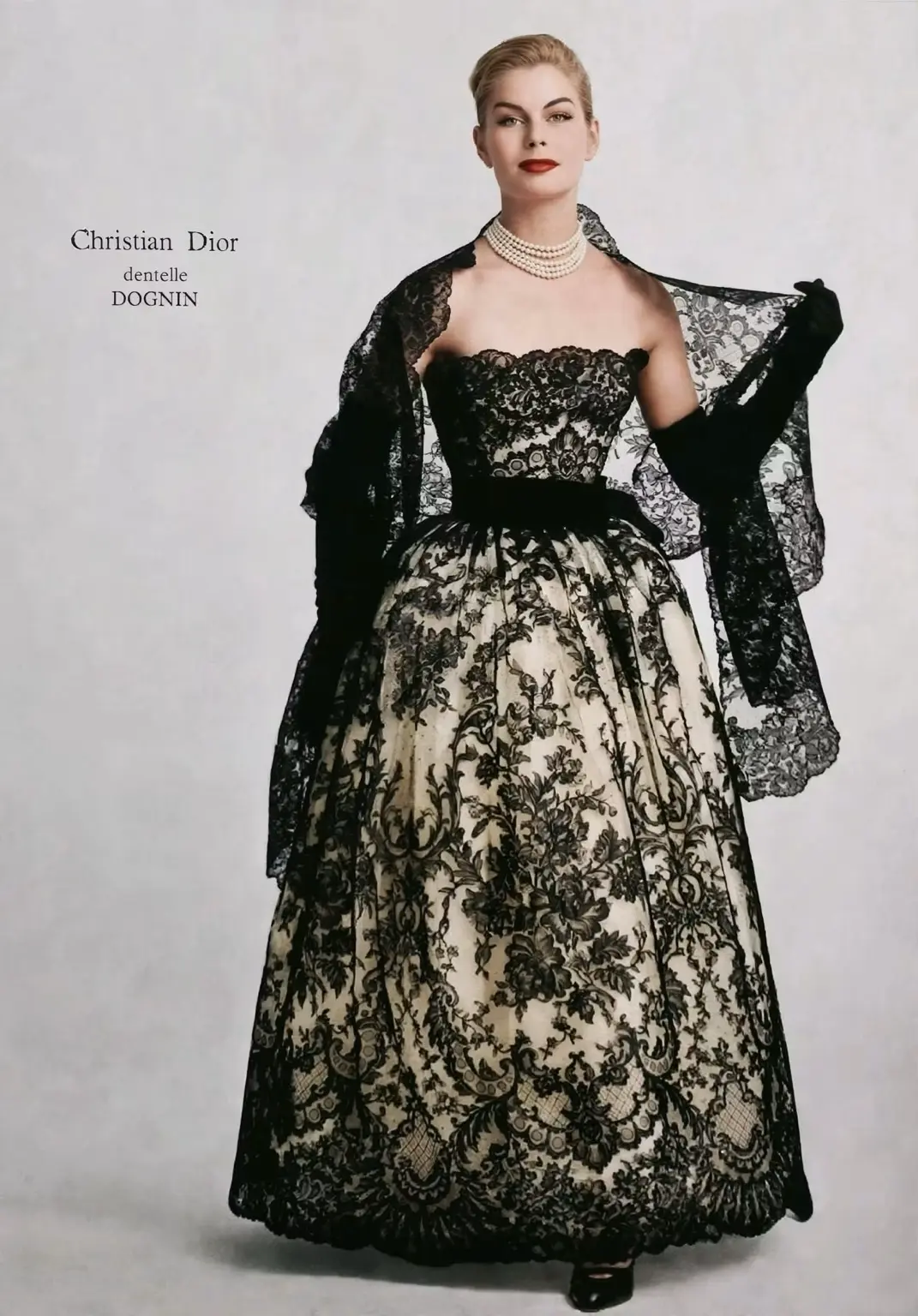
A closer look at an image bearing the names Christian Dior and Dognin, exploring how lace, silhouette and accessories come together in an evening ensemble.
Article Content
Dior and Dognin Lace: When Fabric Takes Centre Stage
Black lace over a pale ground, a defined waist, a full-length skirt and a shawl opened out between the wearer’s arms.
The image bears the names Christian Dior and “dentelle DOGNIN.” Dentelle is French for lace, bringing attention to both the fashion house and a name associated with the textile.
- Lace as a Central Design Element
Lace extends across the bodice and skirt, with botanical motifs clearly visible against the lighter material beneath.
The image allows us to observe the pattern and its placement. It does not establish this lace’s fibre composition, manufacturing method or whether it was handmade.
- A Silhouette That Displays the Pattern
The dress appears strapless, with a scalloped upper edge, a close-fitting bodice, a broad black waist detail and a full skirt.
As a visual reading, the plain waist section separates the patterned areas, while the skirt provides a larger surface for the motifs.
This describes the visible appearance rather than identifying the garment’s internal construction or support.
- A Shawl That Reveals Transparency
A black lace shawl extends around the shoulders and arms. Against the pale background, its motifs appear differently from those layered over the dress.
This offers a useful comparison: the appearance of an open textile depends partly on what can be seen through and behind it.
- Accessories Complete the Composition
Long black gloves, a multi-strand pearl-like necklace and a visible black shoe accompany the dress.
Visually, black repeats across the clothing and accessories, while the necklace introduces a light detail near the face. The photograph alone cannot confirm the necklace or glove materials.
- What Do We Know About Dognin?
The Metropolitan Museum of Art records a French panel of black silk machine-made lace attributed to the Dognin-Racine Company.
Palais Galliera also documents Dognin tulle in “Zéphyrine,” a House of Dior dress designed by Yves Saint Laurent for autumn–winter 1958–1959. This is a separate documented example, not the dress pictured here.
These records establish relevant textile and fashion context, but do not confirm the supplied image’s date or the name of its design.
What Can We Learn from the Image?
The ensemble invites us to examine pattern against background, plain areas beside decoration, and the repetition of lace across a dress and shawl.
It also draws attention to a textile maker’s name alongside a fashion house. Studying an outfit includes considering its fabric as well as its silhouette.
From the Memory of Days
Rana Elgogary ᥫ᭡
Expert Tip
«When examining lace, look at both its pattern and the background visible through it.»
Conclusion
The image presents an evening ensemble featuring black lace over a pale ground, a defined waist, a shawl and long gloves. Its details offer a study of fabric, silhouette and accessories without assuming an undocumented date or construction method.