5 min read
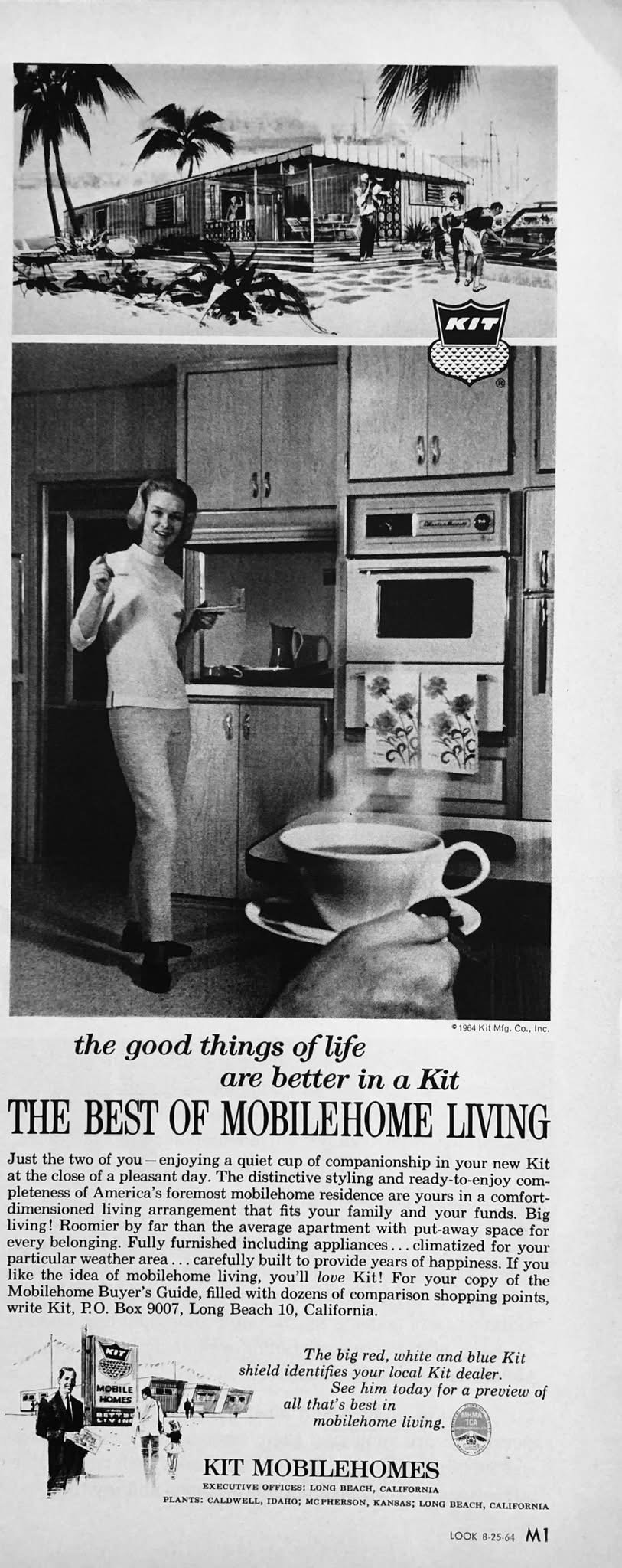
A 1964 American advertisement for Kit takes us into the world of mobile-home living in the 1960s, when advertising offered more than a home—it presented an entire vision of life inside it. From the fitted kitchen and household appliances to family living and everyday comfort, this vintage page reveals how ideas of modern home life were presented more than sixty years ago.
Article Content
The Mobile Home in 1964… When Home Became a Way of Life
Looking at this advertisement today, our attention may first be drawn to the woman standing in the kitchen, the built-in oven, the refrigerator, or perhaps the oversized coffee cup dominating the foreground.
Yet this 1964 Kit advertisement was selling something much bigger than a kitchen or a collection of household appliances.
It was selling an idea of life.
At the top of the page, a mobile home appears beneath palm trees, surrounded by people, a car, and an outdoor setting that suggests comfortable family living.
Inside, we find an organized, fully equipped kitchen and a woman enjoying a quiet moment in what would have appeared to contemporary viewers as a modern home.
The advertisement declares:
“the good things of life are better in a Kit”
followed by:
“THE BEST OF MOBILEHOME LIVING.”
And that is where the story becomes particularly interesting.
What Was a Mobile Home?
The term “mobile home” can suggest a small house constantly traveling from place to place, but historically the picture was more complex.
These homes were factory-built and transported to their locations, where many remained for extended periods.
Kit Manufacturing Co. began with small trailers in the mid-1940s and later expanded its operations. Historical records indicate that the company began producing mobile homes at its Caldwell, Idaho plant in 1958.
By the 1960s, the concept had developed far beyond a small travel trailer. Factory-built housing was increasingly presented as a living space capable of providing many of the comforts associated with a conventional home.
The Advertisement Was Selling Life Inside the Home
Rather than simply showing the exterior and listing technical specifications, the advertisement made life inside the home central to its message.
We see the kitchen.
We see the appliances.
We see the woman.
We see the coffee.
And above, we see the home situated in an inviting outdoor environment.
The advertising copy even introduces the idea of two people enjoying a quiet cup together at the end of a pleasant day in their new Kit home.
The product was therefore presented as more than walls and a roof.
The message was essentially:
This is a place where you can live your life.
A Kitchen That Represented Modernity
Look closely at the interior photograph and several details reveal what a modern kitchen could look like in the 1960s.
Simple cabinetry.
A large refrigerator.
A built-in oven.
Storage.
Countertop appliances.
And an orderly overall design.
The advertisement also emphasizes furnishings, appliances, storage, and comfortable living.
Seen more than sixty years later, the image has become a small visual document of American kitchen and interior design history.
What appeared modern to a consumer in 1964 now carries the unmistakable character of its era.
The Woman in the Advertisement
Her presence is equally significant.
Domestic imagery was frequently used in mid-century advertising to associate homes and household products with comfort, convenience, and modern living.
Here, she appears elegantly dressed in an organized kitchen, holding a small cup while an enormous cup in the foreground visually reinforces the idea of relaxation and enjoyment.
Yet vintage advertising should not be interpreted as a neutral documentary record of everyday life.
Advertising shows us the lifestyle a brand wanted consumers to imagine.
For that reason, it tells us about aspirations and marketing culture as much as it tells us about daily reality.
From a Small Trailer to the Idea of Home
Kit’s history adds another layer to the advertisement.
The company began in October 1945 with the Kit Kamper project. Its original concept involved trailer kits that buyers could assemble themselves, but the company soon moved toward completed trailers. Its public debut in 1946 attracted substantial interest.
Over the following years, Kit expanded into larger products and began manufacturing mobile homes in 1958.
The 1964 advertisement therefore represents a very different stage in that story.
The message was no longer simply:
Here is a trailer you can take with you.
It had become something closer to:
Here is a home in which you can build a life.
More Than Sixty Years Later
Around 62 years have passed since this advertisement appeared.
Kitchens have changed.
Appliances have changed.
Home design has changed.
Manufactured housing has evolved as well.
Yet one idea in the advertisement remains remarkably familiar:
We rarely choose a home only for what it looks like. We also choose it for the life we imagine living inside it.
That is precisely what this Kit advertisement attempted to sell in 1964.
Not simply a mobile home, but an entire scene:
a home, a kitchen, comfort, coffee, and space for everyday life.
And perhaps that is why vintage advertisements remain so fascinating.
Products may disappear or change beyond recognition…
but the image an era created of “the good life” can remain preserved on a single page for generations.
Memories of Days Gone By ᥫ᭡
Rana Elgogary
Expert Tip
«Look inside old homes, not only at their exteriors… Kitchens, furniture, appliances, and small everyday details can sometimes tell us more about how a generation lived than the façade of the home itself. Memories of Days Gone By ᥫ᭡ Rana Elgogary»
Conclusion
A 1964 Kit advertisement takes us back to a period when mobile homes were increasingly presented as more than trailers—they were marketed as equipped living spaces associated with comfort and family life. Through its kitchen, appliances, furnishings, imagery, and advertising language, the page offers a fascinating glimpse into how the idea of the “modern home” was marketed in the 1960s and how vintage advertising can preserve the visual culture of its era.