5 min read
An outfit can be made of very simple pieces and still look polished at first glance. The secret is often not the number or price of the pieces, but a combination of thoughtful details: proper fit, balanced proportions, harmonious colors, well-maintained garments, and carefully chosen shoes, bags, and accessories. In this article, we explore the details that make a simple outfit look more refined and cohesive—and how small adjustments can noticeably improve the overall result.
Article Content
Why Do Some Outfits Look Polished Even When They’re Simple?
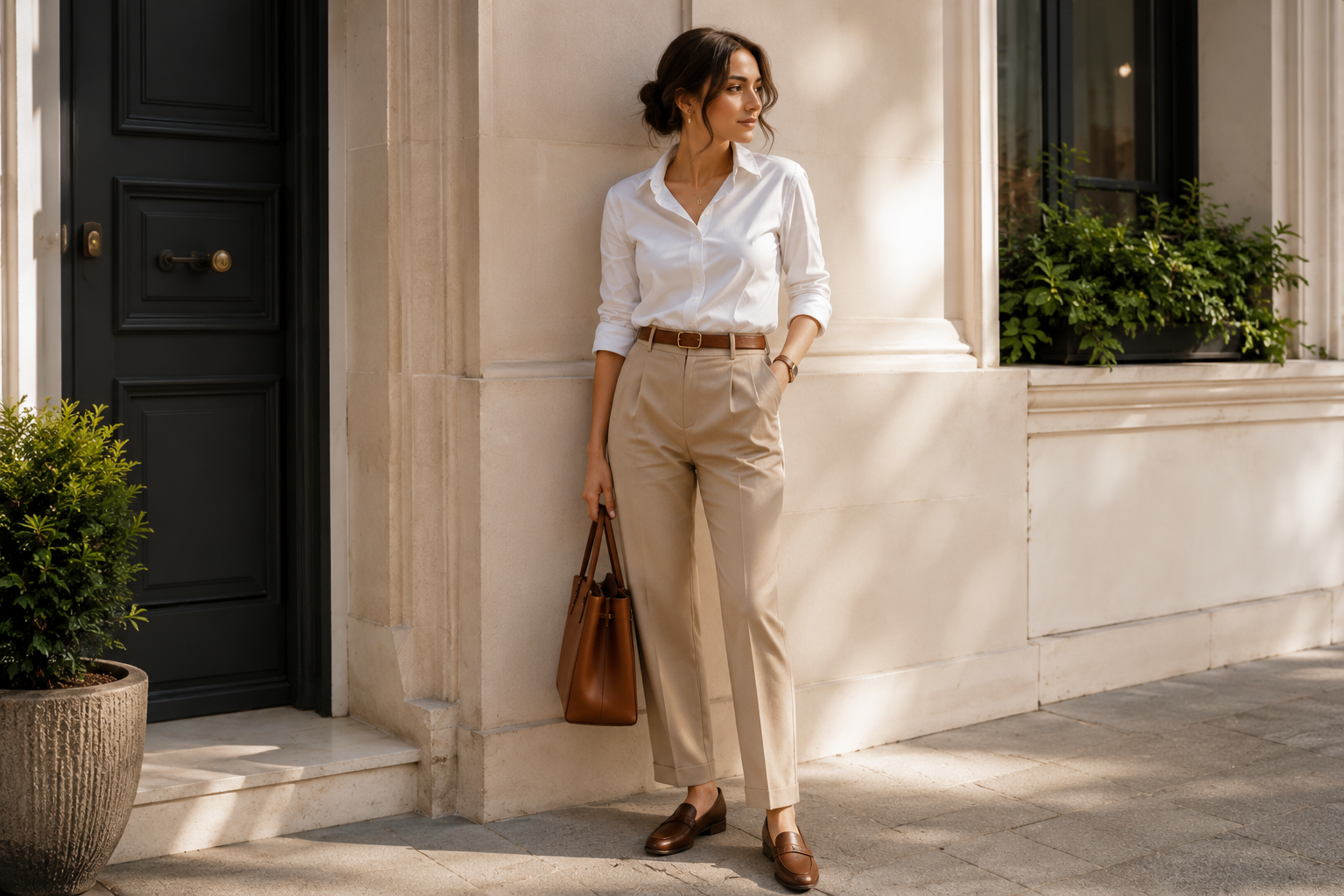
You may have seen an outfit consisting of nothing more than simple trousers, a shirt, and understated shoes, yet somehow it looks effortlessly polished.
There may be no statement piece, no abundance of accessories, and nothing particularly extraordinary on its own.
Still, something makes the entire look feel refined and put together.
On the other hand, another outfit may contain individually beautiful pieces, yet they do not create the same effect when worn together.
So, what makes the difference?
Usually, it is not one particular item. It is the relationship between all the details.
A polished outfit does not have to be complicated or expensive. Its elements simply need to look as though they were chosen to work together.
1. Proper Fit Comes Before Design
A garment may have a beautiful design, excellent fabric, and a flattering color, but if it does not fit properly, the entire outfit can lose some of its polish.
Proper fit does not mean tight clothing.
It means that the garment sits on the body as its design intends: shoulders fall in the right place, sleeves and hems are considered, trousers do not bunch unintentionally, and a jacket looks neither strained nor unnecessarily oversized.
This is the difference between the size printed on a label and how a garment actually fits your body.
Bodies vary, and so do cuts between brands.
The number is not the goal.
How the garment looks and feels on you is what matters.
2. Simplicity Requires Attention to Detail
We often assume that simple outfits are the easiest, but simplicity actually makes details more visible.
When only a few pieces are involved, the cut of the trousers, the length of the shirt, the condition of the shoes, the shape of the bag, and the way the fabric falls become more noticeable.
This is why an extremely simple outfit can look exceptional when its details are considered carefully.
Successful simplicity is not the absence of detail.
It is choosing only the details that matter.
3. Balanced Proportions Change Everything
The relationship between the lengths and volumes of garments plays an important role in creating a cohesive outfit.
When both the top and bottom are very voluminous, for example, the look may benefit from an element that introduces definition.
If a jacket is long, the length of the trousers or skirt and the choice of footwear can influence the overall visual balance.
There is no single formula that works for every woman or every garment.
The key principle is simple:
Do not look at each piece in isolation; look at the complete picture.
Sometimes an outfit does not require different clothes at all. A small styling adjustment—rolling a sleeve, partially tucking a shirt, or choosing a different jacket length—may be enough.
4. Colors Do Not Have to Match Exactly
A polished outfit does not require wearing one color from head to toe, nor must the shoes, bag, and belt match perfectly.
What matters more is visual harmony between the colors.
An outfit might use a neutral foundation with one softer accent, several shades from the same color family, or different colors connected by a similar level of intensity.
Before introducing another color, ask:
Does it support the outfit or distract from it?
5. Garment Condition Is Part of Style
This is one of the simplest details, yet one of the most influential.
A beautiful but wrinkled shirt, dirty shoes, a misshapen bag, or a garment covered in lint can make an outfit appear less polished regardless of the quality of the individual pieces.
Garment care is not separate from style.
It is part of it.
Steaming, removing lint, cleaning shoes, storing bags properly, and noticing loose threads, buttons, and finishing details can significantly improve simple clothes.
Sometimes caring better for what you already own makes a greater difference than buying something new.
6. Fabric Influences the Final Look
Fabric affects not only how a garment feels but also how it falls and maintains its shape.
Some materials create structure, others offer fluidity, some wrinkle easily, and others retain a crisp appearance for longer.
Thoughtfully combining different textures can also give a simple, neutral outfit visual depth without requiring additional colors or accessories.
7. Shoes Can Change the Entire Message
Imagine the same trousers and shirt worn first with clean sneakers, then loafers, and finally heels.
The core clothing remains unchanged, yet the level of formality and visual message changes considerably.
Shoes should therefore not be treated simply as something chosen after the outfit is complete.
They are part of building the look from the beginning.
8. A Bag Is More Than Something That Carries Your Belongings
A bag carries visual weight within an outfit.
Its size, structure, material, and level of formality can all influence the final result.
A structured bag may add polish to a simple outfit, while a softer, more relaxed style may complement an entirely different look.
The bag does not need to be expensive.
Its shape, condition, and character simply need to suit the outfit and occasion.
9. Accessories Should Complete, Not Compete
There is a difference between accessories that finish an outfit and accessories that begin competing with it.
A watch, earrings, necklace, belt, or scarf may provide exactly the detail an outfit needs.
But wearing everything at once is not a requirement for style.
A strong outfit may need fewer additions, while a very simple look may benefit from one carefully selected focal detail.
A good accessory does not always have to be the first thing people notice; sometimes its role is simply to make the whole look feel complete.
10. Grooming Is Part of the Complete Picture
Even when discussing clothing, the finished look extends beyond garments.
Neatly styled hair or a carefully arranged hijab, clean nails, and an overall well-groomed appearance can support the clothes and help create visual consistency.
This does not require elaborate hairstyles or full makeup.
The principle is simply care and consistency.
11. Give the Outfit Some Space
Sometimes the question should not be:
What is missing?
Instead, ask:
Does this outfit actually need anything else?
It is easy to keep adding another accessory, a stronger bag, a belt, another layer, or an additional color.
But some outfits improve when we know when to stop.
Visual breathing room is part of balance too.
12. Look at the Outfit as One Complete Image
Once you are dressed, step slightly away from the mirror and look at the entire outfit instead of examining individual pieces.
Does one area attract too much attention?
Are the proportions balanced?
Does the footwear belong with the rest of the look?
Does one color feel disconnected?
Do you really need every accessory you are wearing?
Looking at the complete image can reveal details that are easy to miss when each element is considered separately.
Style Can Be Very Quiet
An outfit does not need to demand attention to be elegant.
Sometimes the most successful looks are the ones for which we cannot identify one single reason they work so well.
Nothing is shouting for attention.
The fit is right.
The proportions feel balanced.
The colors are harmonious.
The garments are well cared for.
The shoes and bag support the overall look.
And the details are present only where they are needed.
So, the next time you see a simple outfit that looks exceptionally polished, do not ask only:
“What is she wearing?”
Also ask:
“How have those pieces been brought together?”
Because very often, style is not about having more.
It is about making the details you already have work beautifully together.
Expert Tip
«Before adding something else to your outfit, step back from the mirror and look at the complete picture. Sometimes the look does not need another accessory or another color; it may simply need a small adjustment in fit or proportion—or the removal of something that does not support it. Do not always ask, “What should I add?” Also ask, “Is the outfit already complete?” Your Style ᥫ᭡ Rana Elgogary»
Conclusion
A polished outfit does not require an abundance of clothes or accessories, nor is it necessarily defined by price. The difference is often found in the details: proper fit, balanced proportions, harmonious colors and fabrics, well-maintained garments, and thoughtful choices in shoes, bags, and accessories. Looking at an outfit as one complete image rather than a collection of separate pieces makes it easier to recognize what supports the look and what may be unnecessary. Simple style works beautifully when the details create harmony without competing for attention.