5 min read
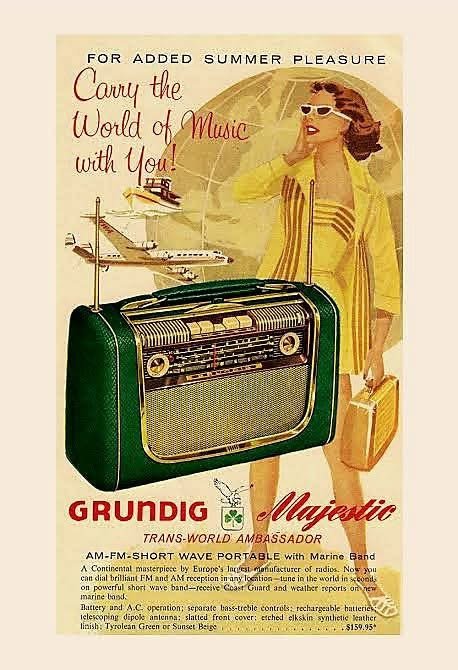
In a vintage advertisement from the 1950s, a stylish woman appears ready to travel, with airplanes and ships behind her and a portable Grundig Majestic radio nearby. The advertisement wasn’t simply selling a listening device. It was selling an exciting idea for its time: the ability to take music—and a connection to the wider world—with you.
Article Content
Carry the World of Music with You…
Today, a small phone gives us instant access to music, radio stations from around the world, podcasts, news, books, and video.
It feels completely ordinary.
Decades ago, however, the idea that sound could travel with you carried a very different meaning.
At the top of this advertisement appears the invitation:
“For Added Summer Pleasure — Carry the World of Music with You!”
The message wasn’t simply buy a new radio.
It was:
the world was becoming something you could take with you.
Why Show a Woman Traveling?
The composition tells much of the story.
A stylish woman in summer clothes and sunglasses carries luggage, while an airplane and ship appear behind her.
The radio dominates the foreground.
Travel, movement, summer, leisure, and technology have all been placed into a single scene.
The radio is therefore presented not merely as electronics, but as part of a modern lifestyle.
What Could the Radio Receive?
The advertisement describes the model as an:
“AM-FM-Short Wave Portable with Marine Band.”
Shortwave broadcasting was particularly meaningful in the pre-internet era because, depending on the station, time, and propagation conditions, broadcasts could be received across considerable distances.
Even its name reinforced the idea:
Trans-World Ambassador.
The radio was being presented as a small audio window onto a much larger world.
“Portable” Meant Something Different
Today, the word portable may suggest something that slips easily into a pocket.
In the 1950s, portability could look quite different.
The radio shown here appears substantial by modern standards, yet being able to move a sophisticated radio from place to place was itself an important benefit.
Technology changes not only our devices.
It can even change what words such as “portable” mean to us.
Grundig During Radio’s Expansion
Grundig was expanding rapidly during this period. By 1952, it had become Europe’s largest radio manufacturer, with one million sets sold, and the company continued developing radios, tape recorders, and televisions throughout the decade.
The advertisement therefore belongs to a broader era in which consumer electronics increasingly represented modernity, mobility, and technological progress.
The Advertisement Was Selling Movement
Rather than showing only a radio and listing its specifications, the advertisement created an entire lifestyle around it:
summer, travel, fashion, airplanes, ships, luggage—and music.
Its underlying promise was remarkably modern:
wherever you go, you don’t have to leave your world behind.
The device has changed enormously since then.
The desire has not.
From a Portable Radio to a World Inside a Phone
More than seventy years later, the transformation is striking.
What once required a dedicated radio can now exist alongside music, television, newspapers, books, maps, cameras, and communication tools inside one small device.
Yet this old advertisement captures an earlier version of the same idea:
content no longer had to wait for us at home—it could travel with us.
That is one reason vintage advertisements are worth revisiting.
They don’t merely preserve what old products looked like.
They preserve moments when things that seem ordinary to us today still looked like part of the future.
“What we carry in a small pocket today once required an entire device—and an advertisement promising that the world could travel with us.”
Memories of Days Gone By ᥫ᭡
Rana Elgogary
Expert Tip
«When looking at a vintage technology advertisement, don’t ask only: “What did this device do?” Also ask: “What new thing did it allow people to do?” That is often where the real story of technology begins. Memories of Days Gone By ᥫ᭡ Rana Elgogary»
Conclusion
This 1950s advertisement for the Grundig Majestic Trans-World Ambassador presented portable radio as more than a listening device. Through travel imagery and the promise to “Carry the World of Music with You,” it connected technology with mobility, leisure, and access to a wider world. What looks large and vintage today represented an important idea at the time: media could begin traveling with its listener.