5 min read
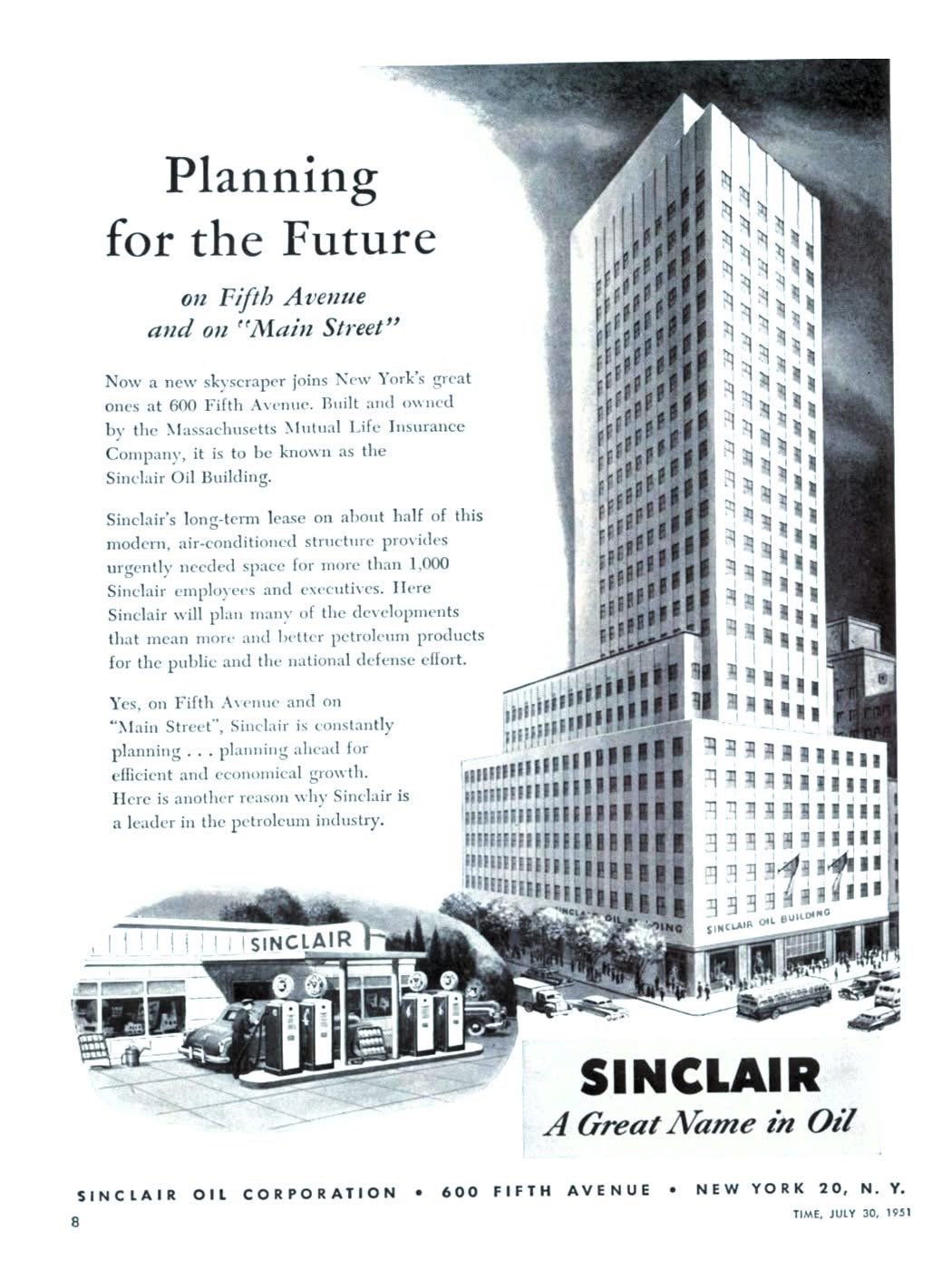
Published in TIME on July 30, 1951, this Sinclair Oil advertisement presented its offices at 600 Fifth Avenue in New York under the headline “Planning for the Future.” A skyscraper, air-conditioned offices, and space for more than a thousand employees and executives represented a powerful image of modernity and progress. So what did “the future” look like 75 years ago?
Article Content
Planning for the Future in 1951… When the Office Building Symbolized Progress
At the bottom of this black-and-white advertisement sits a small Sinclair service station.
Above it rises a skyscraper in New York.
Between the two appears a simple headline:
“Planning for the Future.”
Published in TIME on July 30, 1951, the advertisement was created for Sinclair Oil. Yet it was not primarily selling a gallon of gasoline.
It was selling something else:
the image of a company preparing for the future.
What Did “The Future” Mean in 1951?
The advertisement announces a new skyscraper at 600 Fifth Avenue, owned by Massachusetts Mutual Life Insurance Company and identified in the advertisement as the Sinclair Oil Building.
One detail is particularly revealing.
The building is described as a:
“modern, air-conditioned structure.”
Today, air conditioning in a major office building might seem ordinary.
In 1951, however, it was worth highlighting as part of the language of modernity.
That is one of the fascinating things about vintage advertisements:
what seems ordinary to us can reveal what once felt new.
Space for More Than 1,000 People
According to the advertisement, Sinclair’s long-term lease on about half the building provided needed space for more than 1,000 employees and executives.
From there, the company said it would plan future developments in petroleum products.
The building itself therefore became part of the message.
Its height, scale, location, and modern offices all communicated:
growth, confidence, and preparation for what comes next.
Fifth Avenue and “Main Street”
The advertisement’s subtitle reads:
“on Fifth Avenue and on ‘Main Street’.”
The contrast is clever.
The skyscraper represents Sinclair’s corporate presence on Fifth Avenue.
The service station represents the company’s presence in everyday American life—on the figurative “Main Street.”
The message connects the corporate headquarters with the customer:
planning in New York, serving people across the country.
When a Building Could Represent the Future
Today, companies might describe their future through artificial intelligence, sustainability, digital transformation, or new technology.
In 1951, the visual vocabulary could look different:
a modern skyscraper,
air-conditioned offices,
more than a thousand employees,
and room for expansion.
The advertisement therefore becomes a small document of what progress looked like in its own era.
The Advertisement Isn’t Really Selling Gasoline
Perhaps the most interesting thing about the page is that it belongs to an oil company, yet petroleum products are not its main visual subject.
Sinclair was selling its corporate image:
large, established, expanding, and planning ahead.
The advertisement ends with:
“Sinclair — A Great Name in Oil.”
The building becomes visual evidence for the reputation the company wants to communicate.
Seventy-Five Years Later…
Today, the advertisement looks unmistakably old.
The cars are vintage.
The service station belongs to another era.
The entire page is black and white.
But on July 30, 1951, it was talking about something new.
Growth.
Modern offices.
And the future.
That is perhaps the most beautiful contradiction preserved by vintage advertising:
what looks like the past to us was once someone else’s vision of the future.
And that is why old advertisements can tell us more than what things once looked like.
They can also show us what people once considered progress—and what they imagined tomorrow might become.
Memories of Days Gone By ᥫ᭡
Rana Elgogary
Expert Tip
«When you look at a vintage advertisement, don’t ask only: “What was life like then?” Also ask: “What did they imagine life after them would look like?” Sometimes, the answer is the most fascinating part of looking back. Memories of Days Gone By ᥫ᭡ Rana Elgogary»
Conclusion
In this 1951 TIME advertisement, Sinclair Oil used its offices at 600 Fifth Avenue to communicate growth and preparation for the future. From air-conditioned offices to space for more than 1,000 employees and executives, the page reveals some of the symbols businesses used to represent modernity 75 years ago. And perhaps its most fascinating message today is simple: What looks old to us was once an image of the future.