5 min read
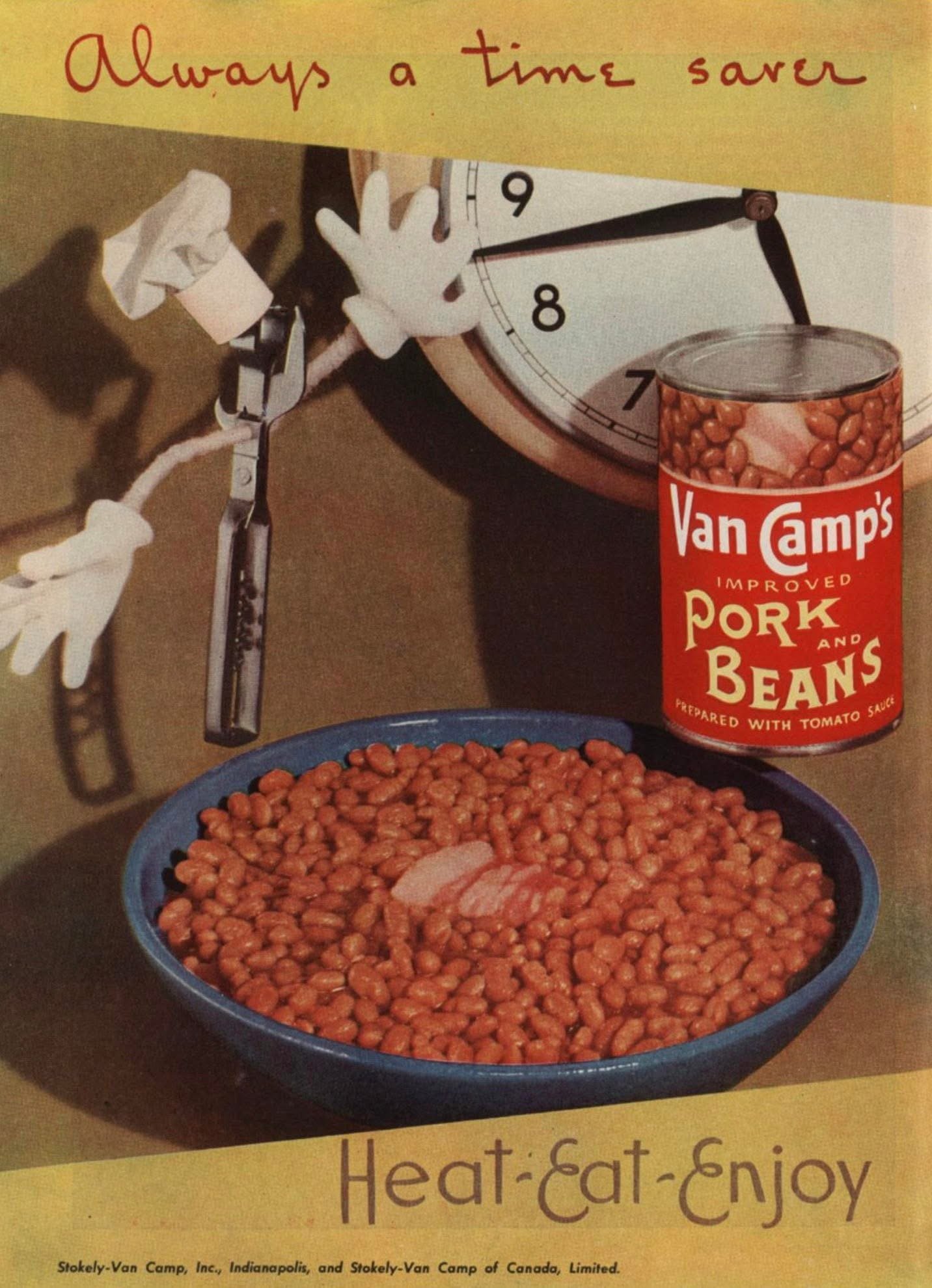
A vintage advertisement for Van Camp’s Pork and Beans takes us back to a time when canned food was increasingly promoted as a practical way to save time in the kitchen. With the phrases “Always a time saver” and “Heat–Eat–Enjoy,” the advertisement reduced meal preparation to a few simple steps: open the can, heat the food, and serve. Behind that simple message, however, lies a larger story about changing domestic life, the rise of convenience foods, and the moment when saving time itself became part of the product being sold.
Article Content
Heat, Eat, Enjoy… When Canned Food Became a Shortcut to Mealtime
Some vintage advertisements need very few words to make their message clear.
A large clock fills the background.
An opened can sits beside a prepared dish.
Across the top are the words:
“Always a time saver.”
And at the bottom:
“Heat – Eat – Enjoy.”
Today, the idea may seem completely ordinary.
We live in a world filled with canned, frozen, prepared, and semi-prepared foods, and finding faster ways to make a meal has become a familiar part of everyday life.
This advertisement, however, takes us back to a period when saving preparation time was itself important enough to become the headline.
The Clock Is There for a Reason
One of the most striking elements in the advertisement is the enormous clock in the background.
It does more than show time.
It tells us what the advertisement is really selling.
The physical product is a can of Van Camp’s Pork and Beans.
But the broader promise is time.
Instead of preparing a dish from the beginning, the consumer could open the can, heat the contents, and serve.
That is why the advertisement needed only three words:
Heat. Eat. Enjoy.
Van Camp’s Story Began Much Earlier
Van Camp’s history in canned foods reaches back into the nineteenth century.
Historical accounts associate Frank Van Camp with the development of the company’s famous pork-and-beans recipe with tomato sauce in 1894. The product expanded rapidly, and Van Camp’s became a major name in the American canned-bean market by the early twentieth century.
In 1933, the business was acquired by James and John Stokely, creating Stokely-Van Camp, the company name visible at the bottom of this advertisement.
From Preserving Food to Saving Time
Canning was fundamentally about preservation—allowing food to remain usable for longer periods.
As the food industry developed, however, another benefit became increasingly marketable:
convenience.
The message was no longer simply:
This food can be stored.
It could also become:
This food can help you prepare a meal quickly.
In that sense, the can contained more than food.
Symbolically, it also contained time saved in preparation.
Three Words That Reduced the Work
The phrase “Heat–Eat–Enjoy” is particularly revealing.
It removes almost everything between the product and the meal.
No lengthy recipe.
No complicated preparation.
The journey from can to table is presented as remarkably short.
Van Camp’s was already using this language in the 1940s; a 1947 trade publication lists its “Heat-Eat-Enjoy” quick-meal marketing alongside Van Camp’s products.
The message was clear:
food that was almost ready when you needed it.
Convenience Food Is Older Than We May Think
Today, the term convenience food may make us think of frozen meals or modern ready-to-eat products.
Yet the desire to make meal preparation faster is much older.
Canning itself changed the relationship between food and time by making foods easier to store and use without always beginning with raw, fresh ingredients.
As food manufacturing and advertising developed, preparation time became an increasingly visible part of a product’s value.
This advertisement captures that transition beautifully.
The Advertisement Is Also a Social Document
Like many historical food and household advertisements, its marketing reflects assumptions about who was responsible for preparing meals and managing the home.
That does not mean the advertisement represents every woman or every household of its era.
Instead, it tells us something else:
who the company imagined its consumer to be and which promise it believed would persuade that consumer.
Time-saving was clearly part of that promise.
Even the Plate Tells the Story
The food is not shown only inside the can.
It appears already served in a large dish beside the package.
There is no complicated arrangement of ingredients and no lengthy cooking process.
Visually, the message is:
This is simple.
The advertisement communicates convenience before the viewer even finishes reading the words.
How Has Our Idea of Convenience Changed?
Today, speed alone may not determine whether we choose a food product.
Consumers may also consider ingredients, nutritional information, sodium, sugar, fat, dietary requirements, cost, and how frequently they want to rely on prepared foods.
That makes the old advertisement even more interesting.
Its central question was:
How much time can this save?
Today’s consumer may ask several questions at once:
Is it convenient?
What is in it?
Does it suit my needs?
How often do I want to use it?
Our definition of convenience has evolved.
What Are We Really Buying When We Buy Convenience?
Perhaps this is the most interesting idea hidden in the advertisement.
When we buy something that saves time, we are not purchasing only the physical product.
We are also purchasing the minutes we no longer need to spend completing the task.
That idea has never disappeared.
We see it today in coffee machines, dishwashers, frozen foods, delivery services, apps, and smart appliances.
The products have changed.
The promise remains remarkably familiar:
I can make part of your life faster and easier.
A Small Advertisement About a Much Bigger Change
Decades later, a can of beans positioned beside a clock may look like a simple vintage image.
But look more closely and it documents an idea that would become enormously important in modern consumer life:
the value of time.
A useful product was no longer valuable only because it performed a function.
Saving effort and saving time could themselves become features worth advertising.
That is why the words:
“Always a time saver”
tell a story much larger than the can beneath them.
They capture a moment when time itself was becoming part of what the product promised to sell.
And what now looks like a charming advertisement from another era once offered a compelling promise:
Heat. Eat. Enjoy.
And the time left over?
That was yours.
Memories of Days Gone By ᥫ᭡
Rana Elgogary
Expert Tip
«When looking at a vintage advertisement, ask yourself: What was being sold beyond the product itself? The image may show a can of food, while the deeper message is about time, convenience, and an easier life. Reading advertisements this way turns them into windows onto the values, needs, and priorities of their time. Memories of Days Gone By ᥫ᭡ Rana Elgogary»
Conclusion
This vintage Van Camp’s advertisement captures a period when speed and time-saving convenience became central to the marketing of canned food. The oversized clock and the phrases “Always a time saver” and “Heat–Eat–Enjoy” sell more than a can of food; they sell the idea of a meal requiring fewer steps and less preparation time. The advertisement shows how canned food evolved from being valued primarily for preservation to also being promoted for convenience—and how the time a product could save became part of its value.